
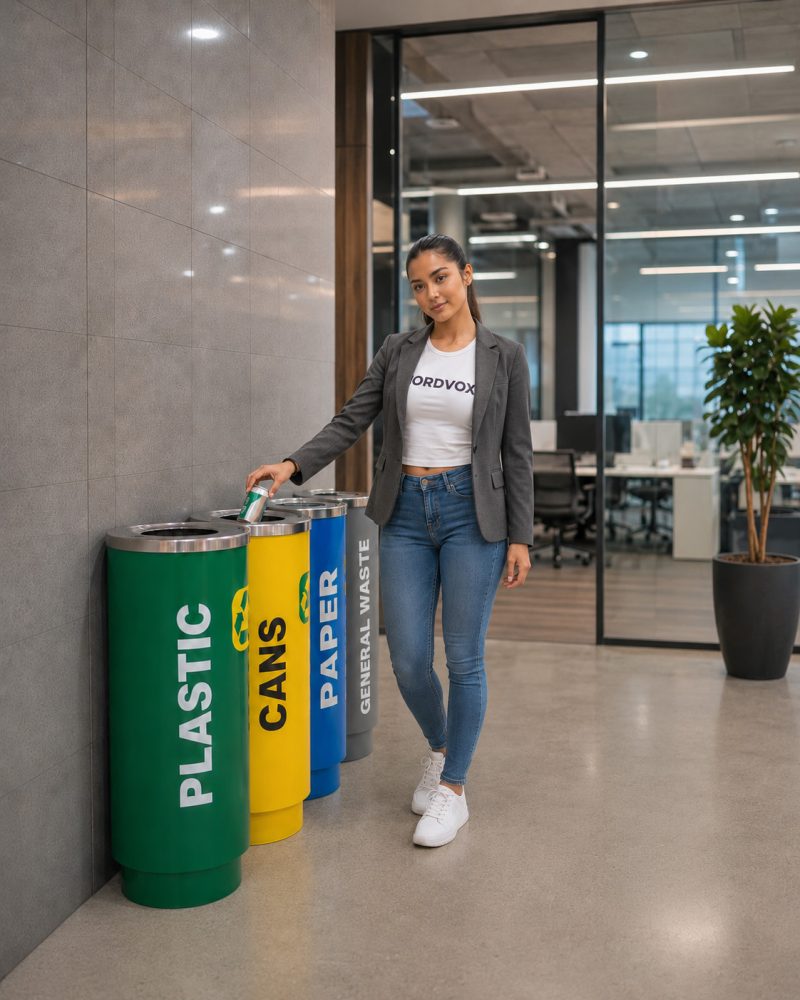
Most Malaysian offices and retail businesses want to recycle more. Far fewer actually sort their waste effectively — and the reason is almost always the same: the wrong bins, in the wrong places, sorting the wrong streams.
Malaysia’s national recycling rate reached 37.9% in 2024, still short of the 40% target set under the Twelfth Malaysia Plan. The gap is not caused by a lack of willingness. Research has repeatedly shown that most Malaysians will separate their waste when the infrastructure is there to make it easy — one study found roughly 90% of Kuala Lumpur households were willing to segregate if bins and facilities were provided. The bottleneck is infrastructure, and in a commercial setting, that infrastructure is your bins.
This guide breaks down what offices and retail businesses actually need to recycle, stream by stream, and which type of bin does each job well. Whether you are setting up a recycling programme for the first time or fixing one that isn’t working, the goal is the same: make the right choice the easy choice for every person who walks past a bin.
Why “Just Add a Recycling Bin” Doesn’t Work
A single blue bin labelled “recycling” fails for a predictable reason: it forces people to guess. When paper, plastic, and cans go into one container, they contaminate each other — a greasy food wrapper or a half-full drink can ruins an entire batch of otherwise recyclable paper. Contaminated recyclables get rejected and sent to landfill anyway.
Effective recycling depends on separation at source — sorting each material into its own clearly marked compartment at the exact moment of disposal. That is why the number of streams your bins sort, and how clearly they are labelled, matters more than how many bins you own.
Recycling in an Office: Paper and Plastic First
Offices generate a specific, predictable waste profile. The overwhelming majority is paper — printouts, documents, packaging, cardboard — followed by plastic and drink containers from pantries and desks. For most offices, a well-run two- or three-stream system captures nearly everything worth recycling.
What an Office Typically Needs
| Location | Recommended setup | Why |
|---|---|---|
| Open-plan work floor | Central 2-in-1 or 3-in-1 station (paper / plastic / general) | Removes under-desk bins, forces a deliberate sort |
| Pantry / breakout area | 3-in-1 station (plastic / cans / general) | Captures drink containers where they’re generated |
| Reception / lobby | Stainless steel 3-in-1 | Presentable finish for client-facing areas |
| Print / copy room | Dedicated paper bin | High-volume single-stream capture |
The most practical starting point for a workplace is a compact multi-stream unit like the R2620-Duo 2-in-1 Recycling Bin for tight pantries, or the more complete R2630-Trio 3-in-1 Recycling Bin for shared floors. For offices that want a purpose-built sorting point rather than a row of bins, the Sortera 3-in-1 Waste Sorting Station is designed specifically for corporate environments, giving each stream its own clearly signed aperture.
Where presentation matters — reception areas, executive floors, meeting suites — the RSS1200-Trio 3-in-1 Stainless Steel Recycling Bin pairs full three-stream sorting with an SS304 finish that suits a client-facing space.
Recycling in Retail & Commercial: Every Stream Counts
Retail stores, shopping malls, and larger commercial premises produce a far broader waste mix than a typical office. Alongside paper and plastic, they generate significant volumes of aluminium cans and glass from food courts and beverage sales, cardboard from stock and deliveries, and — increasingly — textiles and garments from fashion retail and take-back programmes.
For 2024, plastic, metal, and paper were the three dominant recycled materials nationally, at roughly 2.04 million, 1.77 million, and 1.49 million tonnes respectively. A commercial recycling programme that only captures one or two of these is leaving the majority of its recoverable material — and its sustainability reporting numbers — on the table.
The Four-Stream Standard for Commercial Spaces
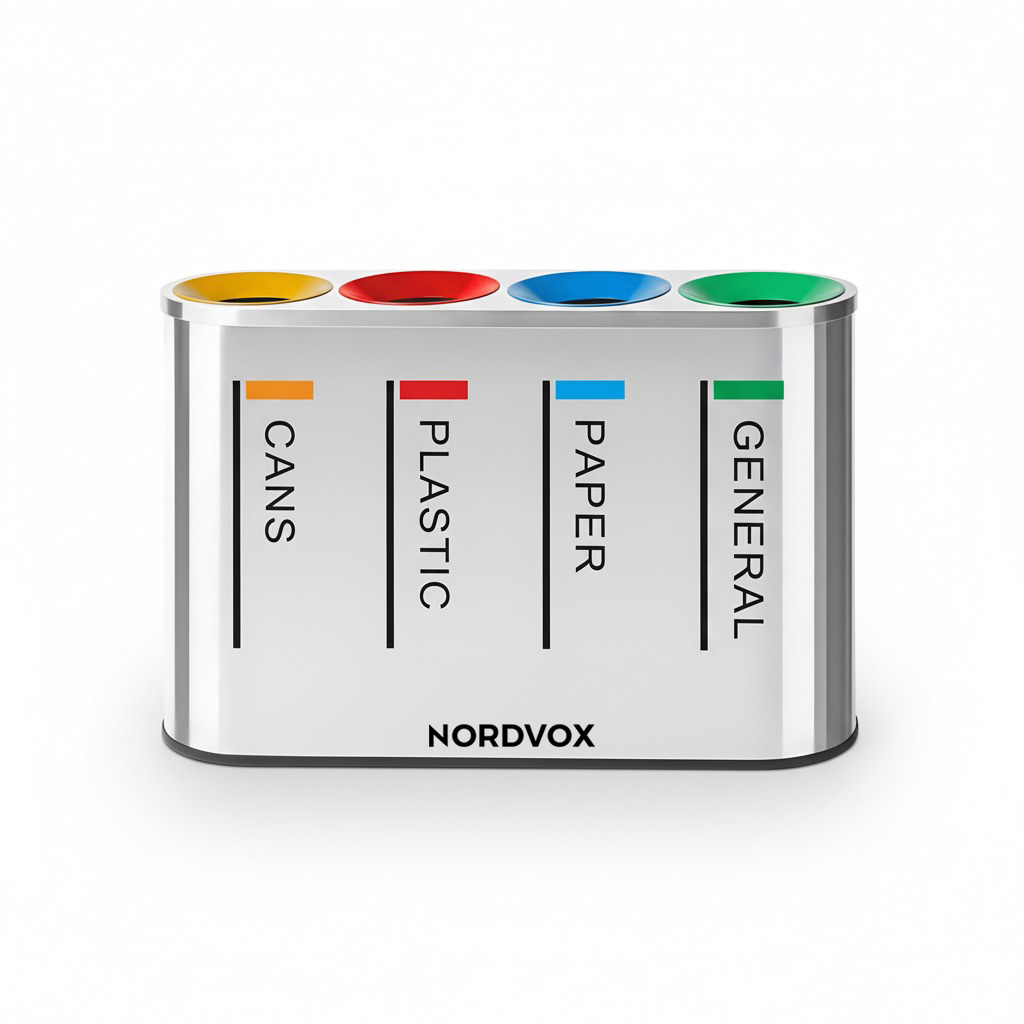
High-traffic retail and commercial areas generally need to sort four streams simultaneously — typically paper, plastic, cans, and general waste. This is where a full four-compartment unit earns its place:
- R2640-Quattro 4-in-1 Recycling Bin — four separate compartments with individual inner liners and customisable graphics, built for malls, food courts, and busy retail floors
- RSS1200-Quadro 4-in-1 Stainless Steel Recycling Bin — a premium SS304 four-stream station for shopping malls, hotels, and government buildings where appearance and durability both matter
- Bottle, Can & Paper Recycling Bin — a focused three-stream unit for beverage-heavy zones like food courts and event spaces
For back-of-house areas, loading bays, and large collection points, high-capacity wheeled sets handle the volume that a standing bin cannot. The Rulla 3 Mobile Recycling Bin (180L) sorts three streams on a wheeled base for easy movement, while MGB240 wheel bin recycling sets and the larger MGB660R Recycle Bin Set handle heavy collection volumes for malls, complexes, and property-wide programmes.
The Stream Most Businesses Miss: Textiles
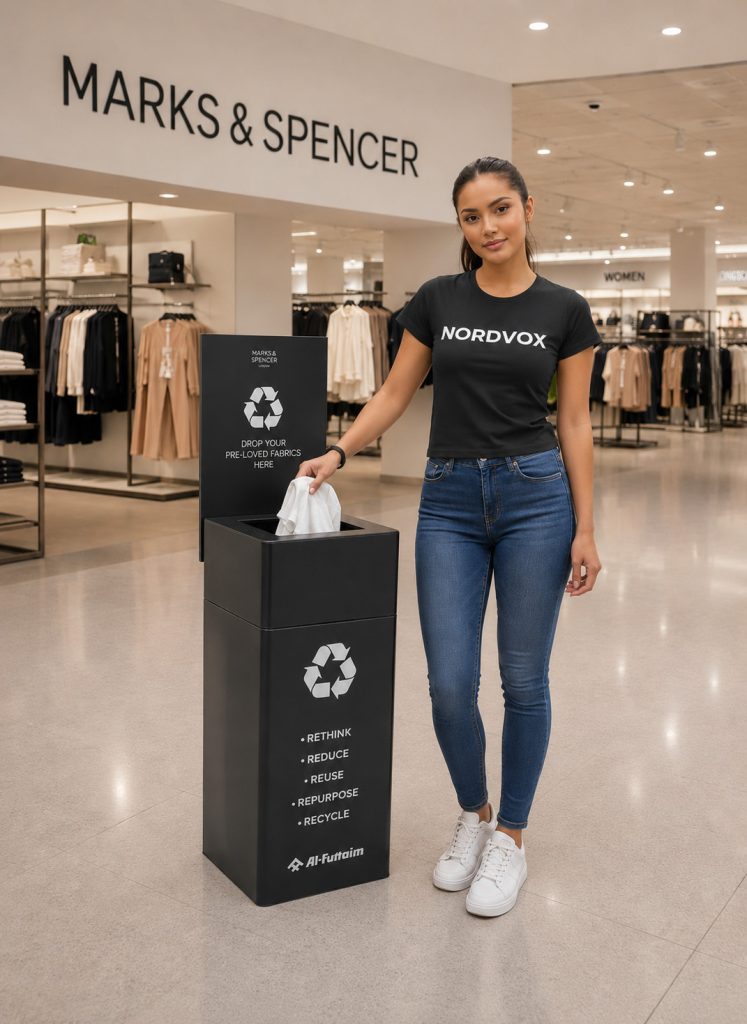
Textile and garment waste is the fastest-growing gap in commercial recycling — and one of the easiest to turn into a visible sustainability win. Fashion retailers, malls, and offices running staff clothing drives are increasingly expected to offer take-back points, particularly as Malaysia’s Extended Producer Responsibility (EPR) framework expands toward the textile sector.
A purpose-built Cloth Donation Bin (CDB-001) gives shoppers and staff a secure, branded place to deposit pre-loved clothing. Because it can carry your logo and campaign messaging, it doubles as a sustainability statement on the retail floor. Explore the full Textile & Clothing Collection Bins range for retail take-back and circular fashion programmes.
How to Choose: A Quick Decision Guide
| Your space | Streams to sort | Start with |
|---|---|---|
| Small office / pantry | Paper, plastic | 2-in-1 or 3-in-1 bin |
| Corporate floor / lobby | Paper, plastic, cans | 3-in-1 station or stainless steel trio |
| Retail store | Paper, plastic, cans, textiles | 4-in-1 bin + cloth donation bin |
| Shopping mall / food court | All streams, high volume | 4-in-1 stainless + wheeled sets |
Three principles apply to every setup, regardless of size:
- Label clearly. Colour-coded, well-signed compartments cut contamination dramatically. Custom graphics that match your brand or Malaysia’s standard recycling colour codes make sorting automatic.
- Place where waste is generated. A recycling bin twenty metres away will not be used. Put the right stream where the waste actually appears.
- Match the material to the environment. HDPE for practical high-turnover areas; SS304 stainless steel for client-facing and premium spaces.
Build a Recycling System, Not Just a Bin Order
NORDVOX has supplied recycling infrastructure to Malaysian offices, malls, retailers, and corporations for over 30 years — including recycling programmes for organisations such as Public Bank, Maybank, and Gamuda Land. Every bin above can be custom-branded and colour-coded, and our team can assess your space to recommend the right stream mix and placement before you order.
Browse the full Recycling Bins range, or explore tailored guidance for your sector:
- Mall Solutions — multi-stream recycling for high-footfall retail environments
- F&B Solutions — for food courts, cafés, and beverage-heavy retail zones
- Condo & Property Solutions — recycling systems for mixed commercial and residential premises
For businesses working through the compliance side of these changes, our guide to Malaysia’s 2026 Waste Reforms explains the regulatory backdrop driving commercial recycling requirements.
Contact NORDVOX for a free recycling assessment and a quote tailored to your office or retail space.
Frequently Asked Questions
What recycling bins does an office need in Malaysia?
Most offices are well served by a 2-in-1 or 3-in-1 recycling bin that separates paper, plastic, and general waste. Paper is the largest waste stream in offices, so a dedicated paper compartment — plus a plastic and cans stream in pantry areas — captures the majority of recyclable material.
How many streams should a retail store recycle?
Retail and commercial spaces typically need to sort four streams — paper, plastic, cans, and general waste — using a 4-in-1 recycling bin. Fashion and lifestyle retailers should also add a textile collection or cloth donation bin to capture garment waste.
Why is waste separation at source important?
Separating recyclables at the moment of disposal prevents cross-contamination. A single contaminated item — such as a food-soiled wrapper — can spoil an entire batch of otherwise recyclable material, causing it to be rejected and sent to landfill. Clearly labelled, multi-compartment bins make correct sorting automatic.
Can NORDVOX recycling bins be branded for our company?
Yes. NORDVOX offers custom colours, logos, graphics, and recycling instructions on its recycling bins — ideal for offices, malls, retailers, and councils that want bins matched to their brand or to Malaysia’s standard recycling colour codes.
What is the recycling colour coding used in Malaysia?
Malaysia commonly uses blue for paper, orange or brown for plastics and other recyclables, and specific streams for cans and glass, alongside general waste. NORDVOX bins can be supplied with labelling and colour coding aligned to national guidelines or to your organisation’s own scheme.


