
The right pedal bin for a Malaysian café or restaurant depends on which side of the counter it sits on. Kitchens and prep areas need a Heavy Duty Pedal Bin — puncture-resistant HDPE in 30L, 50L, or 80L, built to survive grease, wet waste, and constant foot-pedal use. Dining rooms, counters, and restrooms need a Nordic Bin — brushed or matt stainless steel, soft-close, designed to sit in a space guests can see without looking like a bin. NORDVOX supplies both lines and is the official Malaysian distributor for Nordic Bins, so an outlet can specify one supplier for the whole footprint: kitchen to dining room to restroom.
That’s the short answer. The rest of this guide covers why the distinction matters for hygiene grading and waste-law compliance, the full specs on both series, how to size bins by outlet type, and the mistakes that cost F&B operators money and inspection points.
Why Your Pedal Bin Choice Affects More Than Cleanliness
It’s tempting to treat a pedal bin as a commodity — buy whatever’s cheapest, replace it when the pedal breaks. For an F&B outlet in Malaysia, that view is expensive in three specific ways.
It shows up on your hygiene grading
Malaysian restaurants are graded A, B, or C under the Food Hygiene Regulations 2009, and waste disposal accounts for roughly 10% of the total score — one of nine criteria inspectors check, alongside food safety, food handlers, and pest control. The regulation requires premises to stay “free from rubbish, dirt, soot, waste and generic gross things at all time,” with waste removed at least daily. A bin that’s undersized for your covers, doesn’t close properly, or sits open because the pedal mechanism has failed is a visible, avoidable deduction — and grading thresholds vary by council (Petaling Jaya sets Grade A at 75%+, for instance, while other councils use different cut-offs), so a few percentage points can move you a full letter grade.
It’s now a legal requirement, not a courtesy
Under Act 672 (the Solid Waste and Public Cleansing Management Act), source separation of waste has been mandatory since 2020 in Kuala Lumpur, Putrajaya, Johor, and other adopting states. F&B premises in these areas are required to segregate food waste from recyclables and general waste, use a licensed waste collector, and keep disposal records — with fines of up to RM1,000 per violation. The Environmental Quality (Amendment) Act 2024 raised the stakes further for illegal dumping, with penalties up to RM500,000 and personal liability for directors. A single grey bin for everything no longer meets the letter of the law in these areas — you need distinguishable, colour-coded bins for at least food waste, recyclables, and general waste.
The volume is bigger than most operators plan for
Food waste is Malaysia’s single largest waste category — about 30.6% of the national waste stream, or roughly 11,960 tonnes generated every day. At the outlet level, a full-service restaurant generates in the order of 0.5kg of food waste per meal served. A restaurant doing 150 covers a day is looking at roughly 75kg of food waste alone, before general waste and recyclables — which is why so many kitchens end up with bins overflowing between collections, or staff propping lids open because the pedal bin on the line is simply too small.
It’s becoming an ESG reporting line item
For listed hospitality and F&B groups, food waste is no longer just an operational cost — under Malaysia’s National Sustainability Reporting Framework (NSRF), listed companies are required to report food waste volumes, disposal methods, and diversion rates. That reporting is only as accurate as the point of collection: a kitchen that mixes food waste into general waste has no reliable way to measure what it’s diverting, while a kitchen with dedicated, colour-coded bins at source can weigh and report the actual figure. For a franchise or group weighing this now, the segregation habit built for Act 672 compliance and the data trail needed for ESG reporting are effectively the same investment.
Hands-free operation is a food-safety control, not a convenience
Food Safety carries the single largest weight in the hygiene grading system — around 30% of the total score, three times the weight of waste disposal itself. Cross-contamination between raw prep, cooked food, and waste is one of the things inspectors are specifically watching for, and a bin that requires staff to touch a lid with a gloved or bare hand between tasks works against that. A pedal-operated bin isn’t just tidier — it removes one more hand-to-surface contact point on a line where that contact point matters.
None of this is solved by any pedal bin. It’s solved by the right pedal bin, in the right place, in the right size — which is what the rest of this guide sets out to do.
Two Zones, One Standard: Back-of-House vs. Front-of-House
Every F&B outlet effectively runs two different waste environments, and they call for two different bins.
Back-of-house — the kitchen, prep line, dishwashing station, and staff areas — deals with grease, wet scraps, sharp packaging edges, and heavy daily volume. Durability and easy hosing-down matter more than appearance. This is where the Heavy Duty Pedal Bin series belongs.
Front-of-house — the dining floor, self-serve counter, host stand, and guest restroom — is somewhere customers stand next to the bin while it’s in use. Appearance, quiet operation, and odour control matter as much as capacity. This is where the Nordic Bin series belongs.
| Heavy Duty Pedal Bin | Nordic Bin series | |
|---|---|---|
| Material | Puncture-resistant HDPE | Brushed / matt stainless steel |
| Capacity range | 30L, 50L, 80L | 12L to 45L |
| Best placed | Kitchen, prep line, dishwash, staff back-of-house | Dining floor, counters, restrooms, reception |
| Odour control | Overlapping full-open lid | Soft-close lid, dedicated odour filter compartment |
| Cleaning | Hose-down, smooth wipeable surface, no crevices | Removable inner bucket, fingerprint-resistant finish |
| Colour options | 8 standard colours + custom, for segregation | Silver, titanium grey, matt steel |
| Segregation use | Colour-coded by waste stream (Act 672) | Dual-compartment recycling option available |
| Guest-facing | No — utility zones only | Yes — designed to be seen |
Most outlets need both. A café might run one 30L Heavy Duty bin in the prep corner and one Nordic Bin at the counter; a full-service restaurant typically needs several of each, sized to different stations. The sizing section further down works through this by outlet type.
Why the material matters as much as the capacity
The two series aren’t different finishes on the same bin — they’re built for different failure modes. A kitchen bin fails by cracking, staining, or corroding under grease, hot fat, and repeated wet-wipe cleaning; a dining-room bin “fails” by looking worn, sounding loud, or smelling before it looks full. NORDVOX manufactures its HDPE products, including the Heavy Duty Pedal Bin, using the same UV-stabilised injection and rotation moulding processes and EN 840-aligned durability standards it applies across its wider bin range — which is why the kitchen line is plastic rather than the more premium-looking stainless steel: HDPE simply outperforms uncoated steel against grease, acid from food waste, and the abrasion of daily hosing-down. Stainless steel earns its place at the front of house precisely because that environment doesn’t put it through the same punishment.
The Heavy Duty Pedal Bin Series: Built for the Kitchen
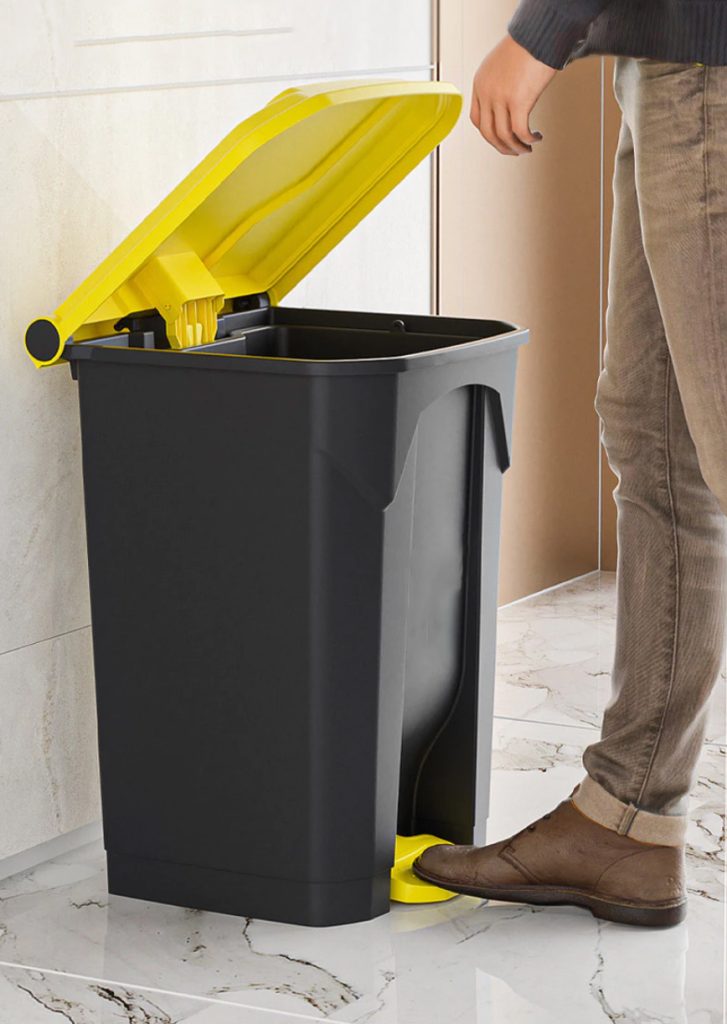
The Heavy Duty Pedal Bin is NORDVOX’s commercial-grade line for exactly the environment a working kitchen puts a bin through: grease, wet food scraps, constant pedal cycles, and the occasional impact from a trolley or crate. It’s built from puncture-resistant HDPE with reinforced body ribs, raised moulded feet that keep the base off wet floors, and a full-opening, overlapping lid designed to contain odour between empties. The body is smooth and wipeable with no crevices for grime to collect in — the same design logic that makes NORDVOX’s wheel bins and MGBs durable in tropical, high-use conditions.
| Model | Capacity | Dimensions (W×D×H) | Best for |
|---|---|---|---|
| PSO30 | 30L | 345 × 330 × 475 mm | Small café prep station, service counter |
| PSO50 | 50L | 410 × 390 × 570 mm | Mid-size kitchen line, dishwash station |
| PSO80 | 80L | 470 × 410 × 680 mm | Full kitchen back door, high-volume prep |
Standard colours: grey, yellow, green, blue, red, brown, black, and beige — eight options, which makes this series a practical fit for colour-coded segregation under Act 672 (for example, green for food waste, blue for recyclables, black for general waste, with the same body style across all three so staff and inspectors can tell at a glance what’s what). Custom colours and printed labels are available for volume orders across multiple outlets or a franchise group.
Applications: restaurant kitchens, hotel back-of-house, central kitchens, cafés, food courts, and any F&B environment where the bin needs to survive daily hosing-down and heavy contact.
View the full Heavy Duty Pedal Bin range → · Browse all pedal bins →
The Nordic Bin Series: Considered Enough for the Dining Room
NORDVOX is the official Malaysian distributor for Nordic Bins — a stainless steel pedal bin line built on the same Scandinavian design principle behind the rest of the NORDVOX range: a well-made object should do its job quietly, without drawing attention to itself. For a restaurant or café, that translates into a very specific, practical requirement — a bin that can stand next to a host stand, a self-serve counter, or a restroom basin and read as part of the interior, not as equipment.
All four models share the core mechanics that make this possible: a soft-close pedal action (no lid-slam next to diners), a removable inner bucket for fast cleaning between shifts, a plastic bag fixer so liners don’t slip during service, and fingerprint-resistant or matt finishes that hold up under constant hand and glove contact.
FRIGG — Split Wing
30L, 445 × 255 × 582 mm. Finished in silver stainless steel or titanium grey, with a stain-resistant surface and an open-top profile suited to kitchens, dining rooms, offices, and restrooms alike. A straightforward, space-efficient shape for counters and corridors.
HODR — Large Capacity Rectangular
30L, 450 × 410 × 650 mm, with a fingerprint-proof coating and a triple-compartment interior built around a dedicated odour-filter section — genuinely useful where food waste sits in a guest-adjacent bin for hours at a time. The soft-closing mechanism is rated odour-proof and noise-free, which matters at a host stand within earshot of a dining room.
BO — Round
Brushed stainless steel in 12L (250 × 250 × 400 mm) and 30L (310 × 310 × 670 mm), with an odour-control rack, multi-liner compatibility, a rear carrying handle, and a soft damper with a fully-open stopper for when staff need both hands free during a busy clear-down. The round profile suits tighter counter corners than the rectangular models.
LINEA — Rectangular Series
The widest size range in the Nordic Bin line: 12L, 20L, 30L, and 45L, in a matt steel finish with a “stay open” function that locks the lid up during heavy use (clear-down, event service) and releases back to soft-close for normal service. Also includes an odour filter compartment and a reinforced back handle.
For front-of-house recycling
Where an outlet needs to visibly separate recyclables at the point of use — a self-serve or quick-service counter, for instance — the Double Liner Recycling Pedal Bin pairs the same stainless steel, soft-close design with two liner compartments in one unit.
How to Size Pedal Bins by Outlet Type
Sizing by “how big is my restaurant” is less useful than sizing by service model, since two restaurants of the same floor area can generate very different waste volumes depending on how food is prepared and served. Use this as a starting point, then adjust for your actual covers and collection frequency.
Small café or kiosk (under 30 seats, light prep): One PSO30 (30L) Heavy Duty bin at the prep counter, plus one FRIGG or BO 12L Nordic Bin at the customer counter. Daily collection is usually enough at this volume.
Casual dining / bistro (30–80 seats, full kitchen): One PSO50 (50L) at the main prep line, a second PSO30 near the dishwash station, and a HODR or LINEA 30L at the host stand or self-serve area. Consider a second, distinctly coloured Heavy Duty bin for food waste segregation if you’re in an Act 672 area.
Full-service restaurant (80+ seats, high-volume kitchen): One or two PSO80 (80L) bins on the kitchen line, colour-coded across general waste, food waste, and recyclables, plus a MGB240 mobile garbage bin at the back door for consolidated collection. Front-of-house typically needs two to three LINEA units at 20–30L distributed between the restroom, host stand, and any self-serve station.
Quick-service / high footfall (fast casual, food court): Favour multiple smaller, frequently emptied bins over one large one — a 20–30L LINEA or Double Liner Recycling Bin at the customer-facing tray return keeps the area presentable during peak periods, backed by PSO50 units in the kitchen for the higher prep volume that fast-casual formats generate.
Hotel F&B outlet (restaurant + banquet + room service): Hotels generate meaningfully more food waste per cover than standalone restaurants — in the range of 1.0–1.8kg per guest per night once room service and banquet functions are included. Kitchens should be sized toward PSO80, ideally more than one, feeding into wheelie bins for bulk collection; front-of-house across multiple outlets is a natural fit for LINEA’s four-size range, since restaurant, lobby bar, and banquet space rarely need the same capacity.
Cloud kitchen / dark kitchen (delivery-only, high packaging waste): Packaging and recyclable waste often outweighs food waste in this format. A PSO50 or PSO80 for general kitchen waste alongside a dedicated recycling stream — see NORDVOX’s Recycling Bins range — tends to fit better than a single large bin.
A worked example: sizing a 60-seat bistro
Take a casual dining outlet doing 60 covers a lunch service and 80 at dinner — 140 covers a day. At roughly 0.5kg of food waste per meal, that’s around 70kg of food waste alone, before packaging, prep trimmings, and general waste from the dining floor are added. Split across a PSO50 (50L) at the main prep line and a PSO30 (30L) dedicated to food-waste segregation near the pass, the kitchen has enough capacity to run a full lunch-and-dinner service without emptying mid-shift, while the two-bin split keeps food waste separable at source rather than sorted after the fact — the part of Act 672 compliance that’s easiest to get wrong and expensive to fix retroactively. Front-of-house, a single LINEA 30L at the host stand and a BO 12L in the restroom round out the outlet without either bin standing out to a seated guest.
Placement: Where Each Bin Actually Goes
- Prep stations and cutting boards — a PSO30 or PSO50 within arm’s reach, positioned so the pedal doesn’t sit in the main walking path.
- Dishwashing / pot wash — a PSO50 or PSO80, since scrap volume here is usually higher and wetter than at prep.
- Back door / loading bay — a wheelie bin or MGB, not a pedal bin, for bulk consolidation ahead of collection. See NORDVOX’s Ultimate Guide to Wheelie Bins for sizing that step.
- Host stand / reception — a compact Nordic Bin (BO 12L or FRIGG) that can absorb menus, receipts, and small front-of-house waste without standing out.
- Self-serve or tray-return counters — LINEA or the Double Liner Recycling Bin, sized to the footfall, with clear signage if you’re segregating recyclables here.
- Guest restrooms — a HODR or FRIGG, chosen for the odour-filter compartment over raw capacity, since restroom bins are judged on smell more than size.
Common Mistakes F&B Operators Make With Pedal Bins
Undersizing the kitchen bin to save on floor space. A bin that’s too small for the prep line gets propped open or overflows mid-service — which is both a hygiene grading risk and, frankly, worse for staff workflow than the floor space saved. Size to your busiest shift, not your average one.
Putting a plastic bin where guests can see it. A Heavy Duty Pedal Bin is the right tool for a kitchen and the wrong one for a dining room — it reads as utility equipment exactly where a restaurant is trying to create the opposite impression. This is a large part of why the Nordic Bin line exists as a separate series rather than a single one-size-fits-all product.
Treating segregation as optional. In Kuala Lumpur, Putrajaya, Johor, and other Act 672 states, a single grey bin for everything is no longer compliant. Colour-coding at the point of disposal — not just at the final collection bin — is what actually gets staff to sort correctly in a busy kitchen.
Ignoring odour control near guests. A front-of-house bin without a soft-close lid or odour-filter compartment will smell before it looks full, which is the opposite of the outcome a dining-room bin is meant to deliver. This is why HODR’s odour-filter compartment and LINEA’s odour filter matter more than their capacity numbers.
Buying stainless steel for the kitchen. Uncoated stainless steel scratches and discolours under grease and repeated wet-wipe cleaning in a kitchen environment far faster than HDPE does — it’s a front-of-house material, not a back-of-house one, despite looking more premium on a spec sheet.
Choosing on unit price instead of lifecycle cost. A low-cost imported pedal bin with a thin plastic hinge or a weak pedal spring often fails within months in a busy kitchen — cracked lids, pedals that stick open, hinges that snap under repeated heavy use. Replacing a bin twice a year costs more than buying a puncture-resistant, reinforced one once, before accounting for the hygiene-grading exposure of a bin that’s visibly broken when an inspector walks through.
Standardising Across Multiple Outlets
For a restaurant group or franchise, the more useful decision isn’t which single bin to buy — it’s which system to standardise on across locations. Inconsistent bins between outlets make it harder to train new staff on segregation, harder to audit hygiene compliance centrally, and harder to negotiate volume pricing.
The Heavy Duty Pedal Bin’s eight standard colours and custom-label option exist for exactly this situation: a group can specify one colour-coding scheme — say, green for food waste, blue for recyclables, black for general waste — and apply it identically across every kitchen, with outlet or brand names printed on the bin for larger orders. Front-of-house can follow the same logic with a single Nordic Bin model (LINEA’s four sizes make it easy to keep one design language while varying capacity by outlet size) so that a guest sees the same considered design whether they’re at a flagship location or a smaller satellite outlet. This is the same “one standard across every place” principle NORDVOX applies to its own product range — the goal is one supplier and one specification, not a different bin at every site.
Your F&B Pedal Bin Checklist
- Have you sized your kitchen bin(s) to your busiest shift, not your daily average?
- Do you have a separate, distinguishable bin for food waste if you operate in an Act 672 area (KL, Putrajaya, Johor, or another adopting state)?
- Are your front-of-house bins soft-close and odour-filtered, not just “a smaller version” of your kitchen bin?
- Does your restroom bin prioritise odour control over raw capacity?
- If you operate multiple outlets or a franchise, have you standardised on one colour-coding system across locations?
- Do you have a consolidation bin (wheelie bin or MGB) at the loading bay so pedal bins aren’t being used for bulk storage between collections?
- Have you confirmed your waste collector is licensed, as required alongside source separation under Act 672?
Frequently Asked Questions
What size pedal bin does a small café need? Most cafés under 30 seats do well with a 30L Heavy Duty Pedal Bin (PSO30) in the prep area and a 12L Nordic Bin at the customer counter, with daily collection. Increase to 50L in the kitchen if you run a full breakfast or lunch menu rather than pre-packaged items.
Can the right pedal bin help my restaurant’s hygiene grading? Waste disposal is one of nine criteria in Malaysia’s restaurant hygiene grading and counts for roughly 10% of the score. A properly sized, well-sealed bin that’s emptied at least daily addresses the specific requirement inspectors check, though grading also depends on food safety, pest control, and other factors a bin alone can’t fix.
Is stainless steel or plastic better for a restaurant kitchen? HDPE plastic — like the Heavy Duty Pedal Bin series — is better for kitchens because it resists grease, punctures, and the corrosion that comes from constant wet-wipe cleaning. Stainless steel Nordic Bins are better suited to front-of-house areas where appearance and quiet operation matter more than raw abrasion resistance.
Do I need different coloured bins for recycling in Malaysia? If your outlet is in Kuala Lumpur, Putrajaya, Johor, or another state that has adopted Act 672’s source separation requirement, yes — you need distinguishable bins for at least food waste, recyclables, and general waste, with fines of up to RM1,000 for non-compliance. NORDVOX’s Heavy Duty Pedal Bin comes in eight standard colours for exactly this purpose.
What is Act 672 and does it apply to my restaurant? Act 672 is the Solid Waste and Public Cleansing Management Act, which made source separation of waste mandatory from 2020 onward in Kuala Lumpur, Putrajaya, Johor, and other states that have adopted it. If your outlet operates in one of these areas, you’re required to segregate waste streams and use a licensed collector.
What’s the actual difference between the Heavy Duty and Nordic Bin series? Heavy Duty Pedal Bins are HDPE, built for durability and easy cleaning in back-of-house kitchen environments, in 30–80L sizes. Nordic Bins are stainless steel, built for appearance and quiet operation in guest-facing front-of-house areas, in 12–45L sizes. Most F&B outlets need both — one for the kitchen, one for the dining room.
Can NORDVOX customise pedal bin colours or add branding for multiple outlets? Yes. The Heavy Duty Pedal Bin series is available in custom colours and with printed labels for volume orders, which suits restaurant groups standardising waste segregation or branding across several locations.
Does NORDVOX deliver pedal bins across Malaysia? NORDVOX is based in Bandar Baru Bangi, Selangor, and supplies both series across Peninsular and East Malaysia. Contact the team for delivery timelines and volume pricing for multi-outlet orders.
How often should a restaurant kitchen bin be emptied? Malaysian hygiene regulations require waste removal at least daily, but a kitchen running near its bin’s capacity before that point is a sign the bin is undersized, not that collection needs to happen more often. Sizing to your busiest shift, as covered above, is usually the better fix than emptying more frequently.
Do pedal bins reduce cross-contamination risk in a commercial kitchen? Yes — hands-free, foot-operated disposal removes a hand-to-lid contact point between tasks like raw prep and plating, which is relevant given that food safety carries the largest single weight in Malaysia’s restaurant hygiene grading. It’s one control among many, not a substitute for handwashing or food-handler training.
What’s the difference between a pedal bin and a sensor bin for a restaurant? A pedal bin uses a mechanical foot lever, while a sensor bin opens automatically via a motion sensor. Pedal bins are generally preferred in commercial F&B settings because they have no battery or motor to fail during service and cost less to maintain at volume — sensor bins tend to suit lower-traffic, guest-facing spaces like hotel lobbies more than a working kitchen line.
Why NORDVOX for F&B Waste Infrastructure
NORDVOX has supplied waste management infrastructure in Malaysia since 1993, as a Malaysian-Swedish family business built around a straightforward idea: the places people share — including the kitchens and dining rooms behind an F&B brand — deserve the same standard of design and durability that Scandinavian waste systems have run on for decades. That’s the same thinking behind both series in this guide: a Heavy Duty Pedal Bin that simply survives a working kitchen, and a Nordic Bin considered enough to belong in a dining room. NORDVOX is Malaysia’s official distributor for Nordic Bins and already supplies hotel F&B operations as part of its broader hospitality client base, alongside hospitals, councils, and property developers across Peninsular and East Malaysia.
Get the Right Bin for Every Part of Your Outlet
A kitchen and a dining room are different jobs, and NORDVOX builds a different bin for each — the Heavy Duty Pedal Bin for the parts of your outlet that never stop working, and the Nordic Bin for the parts your guests actually see. As the official Malaysian distributor for Nordic Bins and a Malaysian-Swedish family business supplying waste infrastructure since 1993, NORDVOX can specify both from one place, sized correctly to your covers and consistent across every outlet you run.
Browse the ranges: Heavy Duty Pedal Bins · Nordic Bins
Talk to the team: Request a consultation · WhatsApp / call +603-8926 1301 · info@nordvox.com
Related guides: Complete Waste Bin Buying Guide Malaysia 2026 · Ultimate Guide to Wheelie Bins
Best Pedal Bins for Cafes and Restaurants in Malaysia: Heavy Duty vs. Nordic Bin (2026 Guide)
The right pedal bin for a Malaysian café or restaurant depends on which side of the counter it sits on. Kitchens and prep areas need a Heavy Duty Pedal Bin — puncture-resistant HDPE in 30L, 50L, or 80L, built to survive grease, wet waste, and constant foot-pedal use. Dining rooms, counters, and restrooms need a Nordic Bin — brushed or matt stainless steel, soft-close, designed to sit in a space guests can see without looking like a bin. NORDVOX supplies both lines and is the official Malaysian distributor for Nordic Bins, so an outlet can specify one supplier for the whole footprint: kitchen to dining room to restroom.
That’s the short answer. The rest of this guide covers why the distinction matters for hygiene grading and waste-law compliance, the full specs on both series, how to size bins by outlet type, and the mistakes that cost F&B operators money and inspection points.
Why Your Pedal Bin Choice Affects More Than Cleanliness
It’s tempting to treat a pedal bin as a commodity — buy whatever’s cheapest, replace it when the pedal breaks. For an F&B outlet in Malaysia, that view is expensive in three specific ways.
It shows up on your hygiene grading
Malaysian restaurants are graded A, B, or C under the Food Hygiene Regulations 2009, and waste disposal accounts for roughly 10% of the total score — one of nine criteria inspectors check, alongside food safety, food handlers, and pest control. The regulation requires premises to stay “free from rubbish, dirt, soot, waste and generic gross things at all time,” with waste removed at least daily. A bin that’s undersized for your covers, doesn’t close properly, or sits open because the pedal mechanism has failed is a visible, avoidable deduction — and grading thresholds vary by council (Petaling Jaya sets Grade A at 75%+, for instance, while other councils use different cut-offs), so a few percentage points can move you a full letter grade.
It’s now a legal requirement, not a courtesy
Under Act 672 (the Solid Waste and Public Cleansing Management Act), source separation of waste has been mandatory since 2020 in Kuala Lumpur, Putrajaya, Johor, and other adopting states. F&B premises in these areas are required to segregate food waste from recyclables and general waste, use a licensed waste collector, and keep disposal records — with fines of up to RM1,000 per violation. The Environmental Quality (Amendment) Act 2024 raised the stakes further for illegal dumping, with penalties up to RM500,000 and personal liability for directors. A single grey bin for everything no longer meets the letter of the law in these areas — you need distinguishable, colour-coded bins for at least food waste, recyclables, and general waste.
The volume is bigger than most operators plan for
Food waste is Malaysia’s single largest waste category — about 30.6% of the national waste stream, or roughly 11,960 tonnes generated every day. At the outlet level, a full-service restaurant generates in the order of 0.5kg of food waste per meal served. A restaurant doing 150 covers a day is looking at roughly 75kg of food waste alone, before general waste and recyclables — which is why so many kitchens end up with bins overflowing between collections, or staff propping lids open because the pedal bin on the line is simply too small.
It’s becoming an ESG reporting line item
For listed hospitality and F&B groups, food waste is no longer just an operational cost — under Malaysia’s National Sustainability Reporting Framework (NSRF), listed companies are required to report food waste volumes, disposal methods, and diversion rates. That reporting is only as accurate as the point of collection: a kitchen that mixes food waste into general waste has no reliable way to measure what it’s diverting, while a kitchen with dedicated, colour-coded bins at source can weigh and report the actual figure. For a franchise or group weighing this now, the segregation habit built for Act 672 compliance and the data trail needed for ESG reporting are effectively the same investment.
Hands-free operation is a food-safety control, not a convenience
Food Safety carries the single largest weight in the hygiene grading system — around 30% of the total score, three times the weight of waste disposal itself. Cross-contamination between raw prep, cooked food, and waste is one of the things inspectors are specifically watching for, and a bin that requires staff to touch a lid with a gloved or bare hand between tasks works against that. A pedal-operated bin isn’t just tidier — it removes one more hand-to-surface contact point on a line where that contact point matters.
None of this is solved by any pedal bin. It’s solved by the right pedal bin, in the right place, in the right size — which is what the rest of this guide sets out to do.
Two Zones, One Standard: Back-of-House vs. Front-of-House
Every F&B outlet effectively runs two different waste environments, and they call for two different bins.
Back-of-house — the kitchen, prep line, dishwashing station, and staff areas — deals with grease, wet scraps, sharp packaging edges, and heavy daily volume. Durability and easy hosing-down matter more than appearance. This is where the Heavy Duty Pedal Bin series belongs.
Front-of-house — the dining floor, self-serve counter, host stand, and guest restroom — is somewhere customers stand next to the bin while it’s in use. Appearance, quiet operation, and odour control matter as much as capacity. This is where the Nordic Bin series belongs.
| Heavy Duty Pedal Bin | Nordic Bin series | |
|---|---|---|
| Material | Puncture-resistant HDPE | Brushed / matt stainless steel |
| Capacity range | 30L, 50L, 80L | 12L to 45L |
| Best placed | Kitchen, prep line, dishwash, staff back-of-house | Dining floor, counters, restrooms, reception |
| Odour control | Overlapping full-open lid | Soft-close lid, dedicated odour filter compartment |
| Cleaning | Hose-down, smooth wipeable surface, no crevices | Removable inner bucket, fingerprint-resistant finish |
| Colour options | 8 standard colours + custom, for segregation | Silver, titanium grey, matt steel |
| Segregation use | Colour-coded by waste stream (Act 672) | Dual-compartment recycling option available |
| Guest-facing | No — utility zones only | Yes — designed to be seen |
Most outlets need both. A café might run one 30L Heavy Duty bin in the prep corner and one Nordic Bin at the counter; a full-service restaurant typically needs several of each, sized to different stations. The sizing section further down works through this by outlet type.
Why the material matters as much as the capacity
The two series aren’t different finishes on the same bin — they’re built for different failure modes. A kitchen bin fails by cracking, staining, or corroding under grease, hot fat, and repeated wet-wipe cleaning; a dining-room bin “fails” by looking worn, sounding loud, or smelling before it looks full. NORDVOX manufactures its HDPE products, including the Heavy Duty Pedal Bin, using the same UV-stabilised injection and rotation moulding processes and EN 840-aligned durability standards it applies across its wider bin range — which is why the kitchen line is plastic rather than the more premium-looking stainless steel: HDPE simply outperforms uncoated steel against grease, acid from food waste, and the abrasion of daily hosing-down. Stainless steel earns its place at the front of house precisely because that environment doesn’t put it through the same punishment.
The Heavy Duty Pedal Bin Series: Built for the Kitchen
The Heavy Duty Pedal Bin is NORDVOX’s commercial-grade line for exactly the environment a working kitchen puts a bin through: grease, wet food scraps, constant pedal cycles, and the occasional impact from a trolley or crate. It’s built from puncture-resistant HDPE with reinforced body ribs, raised moulded feet that keep the base off wet floors, and a full-opening, overlapping lid designed to contain odour between empties. The body is smooth and wipeable with no crevices for grime to collect in — the same design logic that makes NORDVOX’s wheel bins and MGBs durable in tropical, high-use conditions.
| Model | Capacity | Dimensions (W×D×H) | Best for |
|---|---|---|---|
| PSO30 | 30L | 345 × 330 × 475 mm | Small café prep station, service counter |
| PSO50 | 50L | 410 × 390 × 570 mm | Mid-size kitchen line, dishwash station |
| PSO80 | 80L | 470 × 410 × 680 mm | Full kitchen back door, high-volume prep |
Standard colours: grey, yellow, green, blue, red, brown, black, and beige — eight options, which makes this series a practical fit for colour-coded segregation under Act 672 (for example, green for food waste, blue for recyclables, black for general waste, with the same body style across all three so staff and inspectors can tell at a glance what’s what). Custom colours and printed labels are available for volume orders across multiple outlets or a franchise group.
Applications: restaurant kitchens, hotel back-of-house, central kitchens, cafés, food courts, and any F&B environment where the bin needs to survive daily hosing-down and heavy contact.
View the full Heavy Duty Pedal Bin range → · Browse all pedal bins →
The Nordic Bin Series: Considered Enough for the Dining Room
NORDVOX is the official Malaysian distributor for Nordic Bins — a stainless steel pedal bin line built on the same Scandinavian design principle behind the rest of the NORDVOX range: a well-made object should do its job quietly, without drawing attention to itself. For a restaurant or café, that translates into a very specific, practical requirement — a bin that can stand next to a host stand, a self-serve counter, or a restroom basin and read as part of the interior, not as equipment.
All four models share the core mechanics that make this possible: a soft-close pedal action (no lid-slam next to diners), a removable inner bucket for fast cleaning between shifts, a plastic bag fixer so liners don’t slip during service, and fingerprint-resistant or matt finishes that hold up under constant hand and glove contact.
FRIGG — Split Wing
30L, 445 × 255 × 582 mm. Finished in silver stainless steel or titanium grey, with a stain-resistant surface and an open-top profile suited to kitchens, dining rooms, offices, and restrooms alike. A straightforward, space-efficient shape for counters and corridors.
HODR — Large Capacity Rectangular
30L, 450 × 410 × 650 mm, with a fingerprint-proof coating and a triple-compartment interior built around a dedicated odour-filter section — genuinely useful where food waste sits in a guest-adjacent bin for hours at a time. The soft-closing mechanism is rated odour-proof and noise-free, which matters at a host stand within earshot of a dining room.
BO — Round
Brushed stainless steel in 12L (250 × 250 × 400 mm) and 30L (310 × 310 × 670 mm), with an odour-control rack, multi-liner compatibility, a rear carrying handle, and a soft damper with a fully-open stopper for when staff need both hands free during a busy clear-down. The round profile suits tighter counter corners than the rectangular models.
LINEA — Rectangular Series
The widest size range in the Nordic Bin line: 12L, 20L, 30L, and 45L, in a matt steel finish with a “stay open” function that locks the lid up during heavy use (clear-down, event service) and releases back to soft-close for normal service. Also includes an odour filter compartment and a reinforced back handle.
For front-of-house recycling
Where an outlet needs to visibly separate recyclables at the point of use — a self-serve or quick-service counter, for instance — the Double Liner Recycling Pedal Bin pairs the same stainless steel, soft-close design with two liner compartments in one unit.
How to Size Pedal Bins by Outlet Type
Sizing by “how big is my restaurant” is less useful than sizing by service model, since two restaurants of the same floor area can generate very different waste volumes depending on how food is prepared and served. Use this as a starting point, then adjust for your actual covers and collection frequency.
Small café or kiosk (under 30 seats, light prep): One PSO30 (30L) Heavy Duty bin at the prep counter, plus one FRIGG or BO 12L Nordic Bin at the customer counter. Daily collection is usually enough at this volume.
Casual dining / bistro (30–80 seats, full kitchen): One PSO50 (50L) at the main prep line, a second PSO30 near the dishwash station, and a HODR or LINEA 30L at the host stand or self-serve area. Consider a second, distinctly coloured Heavy Duty bin for food waste segregation if you’re in an Act 672 area.
Full-service restaurant (80+ seats, high-volume kitchen): One or two PSO80 (80L) bins on the kitchen line, colour-coded across general waste, food waste, and recyclables, plus a MGB240 mobile garbage bin at the back door for consolidated collection. Front-of-house typically needs two to three LINEA units at 20–30L distributed between the restroom, host stand, and any self-serve station.
Quick-service / high footfall (fast casual, food court): Favour multiple smaller, frequently emptied bins over one large one — a 20–30L LINEA or Double Liner Recycling Bin at the customer-facing tray return keeps the area presentable during peak periods, backed by PSO50 units in the kitchen for the higher prep volume that fast-casual formats generate.
Hotel F&B outlet (restaurant + banquet + room service): Hotels generate meaningfully more food waste per cover than standalone restaurants — in the range of 1.0–1.8kg per guest per night once room service and banquet functions are included. Kitchens should be sized toward PSO80, ideally more than one, feeding into wheelie bins for bulk collection; front-of-house across multiple outlets is a natural fit for LINEA’s four-size range, since restaurant, lobby bar, and banquet space rarely need the same capacity.
Cloud kitchen / dark kitchen (delivery-only, high packaging waste): Packaging and recyclable waste often outweighs food waste in this format. A PSO50 or PSO80 for general kitchen waste alongside a dedicated recycling stream — see NORDVOX’s Recycling Bins range — tends to fit better than a single large bin.
A worked example: sizing a 60-seat bistro
Take a casual dining outlet doing 60 covers a lunch service and 80 at dinner — 140 covers a day. At roughly 0.5kg of food waste per meal, that’s around 70kg of food waste alone, before packaging, prep trimmings, and general waste from the dining floor are added. Split across a PSO50 (50L) at the main prep line and a PSO30 (30L) dedicated to food-waste segregation near the pass, the kitchen has enough capacity to run a full lunch-and-dinner service without emptying mid-shift, while the two-bin split keeps food waste separable at source rather than sorted after the fact — the part of Act 672 compliance that’s easiest to get wrong and expensive to fix retroactively. Front-of-house, a single LINEA 30L at the host stand and a BO 12L in the restroom round out the outlet without either bin standing out to a seated guest.
Placement: Where Each Bin Actually Goes
- Prep stations and cutting boards — a PSO30 or PSO50 within arm’s reach, positioned so the pedal doesn’t sit in the main walking path.
- Dishwashing / pot wash — a PSO50 or PSO80, since scrap volume here is usually higher and wetter than at prep.
- Back door / loading bay — a wheelie bin or MGB, not a pedal bin, for bulk consolidation ahead of collection. See NORDVOX’s Ultimate Guide to Wheelie Bins for sizing that step.
- Host stand / reception — a compact Nordic Bin (BO 12L or FRIGG) that can absorb menus, receipts, and small front-of-house waste without standing out.
- Self-serve or tray-return counters — LINEA or the Double Liner Recycling Bin, sized to the footfall, with clear signage if you’re segregating recyclables here.
- Guest restrooms — a HODR or FRIGG, chosen for the odour-filter compartment over raw capacity, since restroom bins are judged on smell more than size.
Common Mistakes F&B Operators Make With Pedal Bins
Undersizing the kitchen bin to save on floor space. A bin that’s too small for the prep line gets propped open or overflows mid-service — which is both a hygiene grading risk and, frankly, worse for staff workflow than the floor space saved. Size to your busiest shift, not your average one.
Putting a plastic bin where guests can see it. A Heavy Duty Pedal Bin is the right tool for a kitchen and the wrong one for a dining room — it reads as utility equipment exactly where a restaurant is trying to create the opposite impression. This is a large part of why the Nordic Bin line exists as a separate series rather than a single one-size-fits-all product.
Treating segregation as optional. In Kuala Lumpur, Putrajaya, Johor, and other Act 672 states, a single grey bin for everything is no longer compliant. Colour-coding at the point of disposal — not just at the final collection bin — is what actually gets staff to sort correctly in a busy kitchen.
Ignoring odour control near guests. A front-of-house bin without a soft-close lid or odour-filter compartment will smell before it looks full, which is the opposite of the outcome a dining-room bin is meant to deliver. This is why HODR’s odour-filter compartment and LINEA’s odour filter matter more than their capacity numbers.
Buying stainless steel for the kitchen. Uncoated stainless steel scratches and discolours under grease and repeated wet-wipe cleaning in a kitchen environment far faster than HDPE does — it’s a front-of-house material, not a back-of-house one, despite looking more premium on a spec sheet.
Choosing on unit price instead of lifecycle cost. A low-cost imported pedal bin with a thin plastic hinge or a weak pedal spring often fails within months in a busy kitchen — cracked lids, pedals that stick open, hinges that snap under repeated heavy use. Replacing a bin twice a year costs more than buying a puncture-resistant, reinforced one once, before accounting for the hygiene-grading exposure of a bin that’s visibly broken when an inspector walks through.
Standardising Across Multiple Outlets
For a restaurant group or franchise, the more useful decision isn’t which single bin to buy — it’s which system to standardise on across locations. Inconsistent bins between outlets make it harder to train new staff on segregation, harder to audit hygiene compliance centrally, and harder to negotiate volume pricing.
The Heavy Duty Pedal Bin’s eight standard colours and custom-label option exist for exactly this situation: a group can specify one colour-coding scheme — say, green for food waste, blue for recyclables, black for general waste — and apply it identically across every kitchen, with outlet or brand names printed on the bin for larger orders. Front-of-house can follow the same logic with a single Nordic Bin model (LINEA’s four sizes make it easy to keep one design language while varying capacity by outlet size) so that a guest sees the same considered design whether they’re at a flagship location or a smaller satellite outlet. This is the same “one standard across every place” principle NORDVOX applies to its own product range — the goal is one supplier and one specification, not a different bin at every site.
Your F&B Pedal Bin Checklist
- Have you sized your kitchen bin(s) to your busiest shift, not your daily average?
- Do you have a separate, distinguishable bin for food waste if you operate in an Act 672 area (KL, Putrajaya, Johor, or another adopting state)?
- Are your front-of-house bins soft-close and odour-filtered, not just “a smaller version” of your kitchen bin?
- Does your restroom bin prioritise odour control over raw capacity?
- If you operate multiple outlets or a franchise, have you standardised on one colour-coding system across locations?
- Do you have a consolidation bin (wheelie bin or MGB) at the loading bay so pedal bins aren’t being used for bulk storage between collections?
- Have you confirmed your waste collector is licensed, as required alongside source separation under Act 672?
Frequently Asked Questions
What size pedal bin does a small café need? Most cafés under 30 seats do well with a 30L Heavy Duty Pedal Bin (PSO30) in the prep area and a 12L Nordic Bin at the customer counter, with daily collection. Increase to 50L in the kitchen if you run a full breakfast or lunch menu rather than pre-packaged items.
Can the right pedal bin help my restaurant’s hygiene grading? Waste disposal is one of nine criteria in Malaysia’s restaurant hygiene grading and counts for roughly 10% of the score. A properly sized, well-sealed bin that’s emptied at least daily addresses the specific requirement inspectors check, though grading also depends on food safety, pest control, and other factors a bin alone can’t fix.
Is stainless steel or plastic better for a restaurant kitchen? HDPE plastic — like the Heavy Duty Pedal Bin series — is better for kitchens because it resists grease, punctures, and the corrosion that comes from constant wet-wipe cleaning. Stainless steel Nordic Bins are better suited to front-of-house areas where appearance and quiet operation matter more than raw abrasion resistance.
Do I need different coloured bins for recycling in Malaysia? If your outlet is in Kuala Lumpur, Putrajaya, Johor, or another state that has adopted Act 672’s source separation requirement, yes — you need distinguishable bins for at least food waste, recyclables, and general waste, with fines of up to RM1,000 for non-compliance. NORDVOX’s Heavy Duty Pedal Bin comes in eight standard colours for exactly this purpose.
What is Act 672 and does it apply to my restaurant? Act 672 is the Solid Waste and Public Cleansing Management Act, which made source separation of waste mandatory from 2020 onward in Kuala Lumpur, Putrajaya, Johor, and other states that have adopted it. If your outlet operates in one of these areas, you’re required to segregate waste streams and use a licensed collector.
What’s the actual difference between the Heavy Duty and Nordic Bin series? Heavy Duty Pedal Bins are HDPE, built for durability and easy cleaning in back-of-house kitchen environments, in 30–80L sizes. Nordic Bins are stainless steel, built for appearance and quiet operation in guest-facing front-of-house areas, in 12–45L sizes. Most F&B outlets need both — one for the kitchen, one for the dining room.
Can NORDVOX customise pedal bin colours or add branding for multiple outlets? Yes. The Heavy Duty Pedal Bin series is available in custom colours and with printed labels for volume orders, which suits restaurant groups standardising waste segregation or branding across several locations.
Does NORDVOX deliver pedal bins across Malaysia? NORDVOX is based in Bandar Baru Bangi, Selangor, and supplies both series across Peninsular and East Malaysia. Contact the team for delivery timelines and volume pricing for multi-outlet orders.
How often should a restaurant kitchen bin be emptied? Malaysian hygiene regulations require waste removal at least daily, but a kitchen running near its bin’s capacity before that point is a sign the bin is undersized, not that collection needs to happen more often. Sizing to your busiest shift, as covered above, is usually the better fix than emptying more frequently.
Do pedal bins reduce cross-contamination risk in a commercial kitchen? Yes — hands-free, foot-operated disposal removes a hand-to-lid contact point between tasks like raw prep and plating, which is relevant given that food safety carries the largest single weight in Malaysia’s restaurant hygiene grading. It’s one control among many, not a substitute for handwashing or food-handler training.
What’s the difference between a pedal bin and a sensor bin for a restaurant? A pedal bin uses a mechanical foot lever, while a sensor bin opens automatically via a motion sensor. Pedal bins are generally preferred in commercial F&B settings because they have no battery or motor to fail during service and cost less to maintain at volume — sensor bins tend to suit lower-traffic, guest-facing spaces like hotel lobbies more than a working kitchen line.
Why NORDVOX for F&B Waste Infrastructure
NORDVOX has supplied waste management infrastructure in Malaysia since 1993, as a Malaysian-Swedish family business built around a straightforward idea: the places people share — including the kitchens and dining rooms behind an F&B brand — deserve the same standard of design and durability that Scandinavian waste systems have run on for decades. That’s the same thinking behind both series in this guide: a Heavy Duty Pedal Bin that simply survives a working kitchen, and a Nordic Bin considered enough to belong in a dining room. NORDVOX is Malaysia’s official distributor for Nordic Bins and already supplies hotel F&B operations as part of its broader hospitality client base, alongside hospitals, councils, and property developers across Peninsular and East Malaysia.
Get the Right Bin for Every Part of Your Outlet
A kitchen and a dining room are different jobs, and NORDVOX builds a different bin for each — the Heavy Duty Pedal Bin for the parts of your outlet that never stop working, and the Nordic Bin for the parts your guests actually see. As the official Malaysian distributor for Nordic Bins and a Malaysian-Swedish family business supplying waste infrastructure since 1993, NORDVOX can specify both from one place, sized correctly to your covers and consistent across every outlet you run.
Browse the ranges: Heavy Duty Pedal Bins · Nordic Bins
Talk to the team: Request a consultation · WhatsApp / call +603-8926 1301 · info@nordvox.com
Related guides: Complete Waste Bin Buying Guide Malaysia 2026 · Ultimate Guide to Wheelie Bins


