
Here is the most expensive misunderstanding in bollard procurement: a stainless steel bollard will not stop a vehicle.
It looks like it should. It is solid metal, a metre tall, bolted to concrete. However, a standard architectural bollard is designed to mark a boundary and discourage a driver — not to absorb the kinetic energy of a moving vehicle. If your site genuinely needs anti-ram protection, that is a different product class entirely, and one that has been physically crash-tested to prove it works.
This guide covers the types of bollards available, how to choose between them, what crash ratings actually mean, and how to verify a supplier’s claims before you order.
Contents
- The four types by function
- Architectural bollards — what they actually do
- Crash-rated bollards — the different product class
- What K4, M50, and IWA 14-1 mean
- Certified vs engineered — the distinction that matters
- Do not over-specify
- Material and finish for Malaysian conditions
- Installation — the part most people skip
- Which type for your site
- Frequently asked questions
The Four Types by Function
Before considering material or finish, decide how the access point needs to behave. Consequently, this is the first question to answer.
| Type | How it works | Best for |
| Fixed | Permanently installed, no movement | Pedestrian zones, building frontages, permanent boundaries |
| Removable | Lifts out of a ground socket with a key | Occasional deliveries, emergency vehicle access, event load-in |
| Retractable | Drops into a below-ground housing | Frequent access, controlled entry lanes, valet zones |
| Folding | Hinges down flat, padlocked upright | Reserved parking bays, low-budget occasional access |
Retractable bollards come in manual, semi-automatic, and fully automatic versions. Above all, the more frequently the access point opens, the more the automation earns its cost — a manual retractable that staff must operate twenty times a day becomes a resented chore within a month.
Architectural Bollards — What They Actually Do
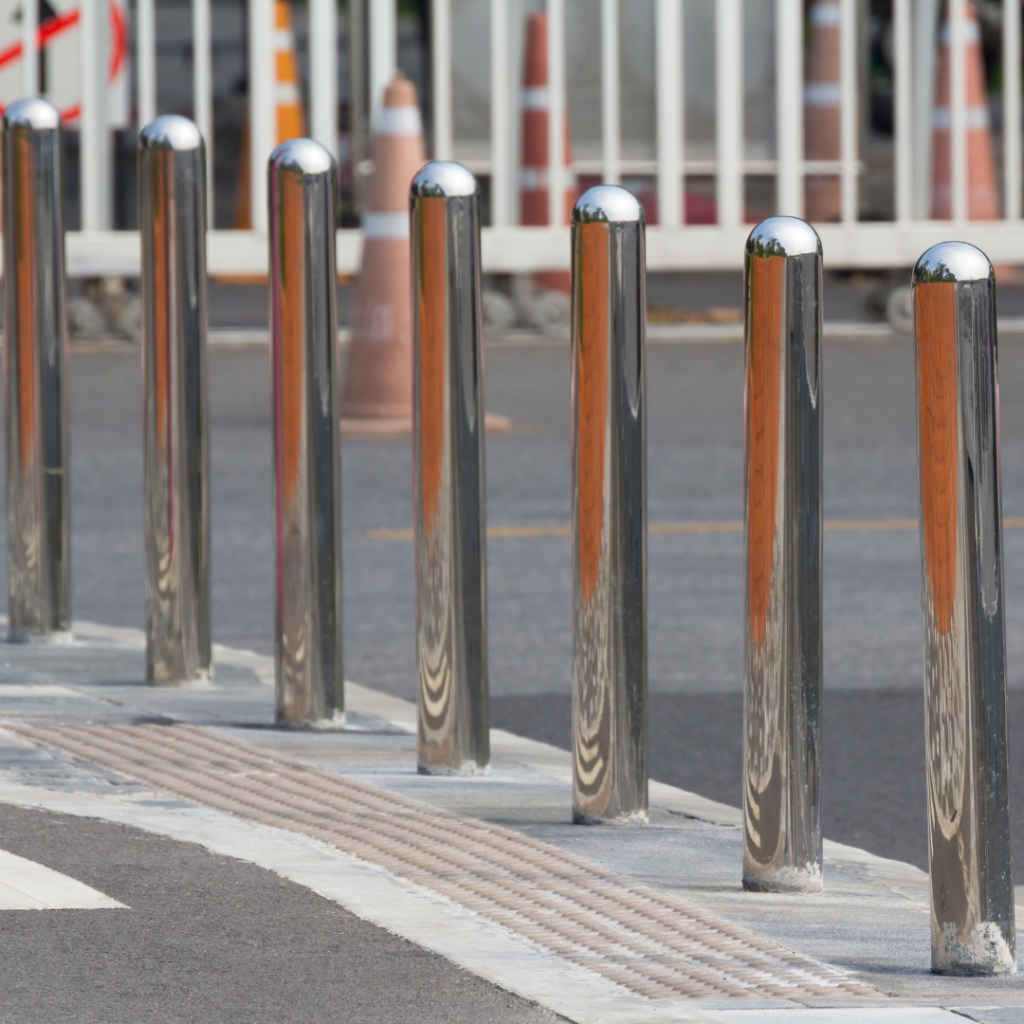
The vast majority of bollards installed in Malaysia are architectural. A stainless steel tube, typically 76mm to 168mm in diameter, surface-mounted on a base plate with anchor bolts or set into a core-drilled hole.
These do four jobs well:
- Define space — separating pedestrian areas from vehicle areas visually and physically.
- Guide movement — channelling foot traffic and queuing at entrances.
- Deter casual encroachment — a driver will not mount a kerb lined with bollards to park closer to the door.
- Protect from low-speed contact — trolleys, reversing manoeuvres, and slow parking errors.
What they do not do is stop a vehicle travelling at speed. A surface-mounted bollard with a 3mm to 5mm wall will shear at the base plate or fold. Therefore, if the risk you are mitigating is a vehicle entering the space at more than walking pace, an architectural bollard is the wrong specification — regardless of how substantial it looks.
This is not a criticism of the product. It is the correct product for the job it was designed to do, and for most Malaysian commercial sites that job is exactly what is needed.
Crash-Rated Bollards — The Different Product Class
Crash-rated bollards, sometimes called anti-ram or hostile vehicle mitigation (HVM) bollards, are engineered to absorb and dissipate the energy of a vehicle impact. Consequently, they look similar above ground but differ completely below it.
Three things separate them:
- Foundation depth — a high-rated bollard may require a reinforced concrete foundation exceeding two metres deep, engineered as part of the system rather than poured to a general spec.
- Section and reinforcement — diameters of 275mm or more, with internal reinforcement and substantially heavier wall sections.
- Physical crash testing — the unit has been driven into by a loaded truck at a certified test facility, on video, with the penetration distance measured.
Shallow-mount crash-rated bollards exist for sites where deep excavation is impossible — near underground services, on a podium deck, or above a basement car park. However, they still require an engineered foundation and cost considerably more than architectural units.
In practice, crash-rated bollards in Malaysia are specified for embassies, government buildings, airports, data centres, stadium perimeters, and increasingly for shopping mall entrances where a vehicle-ramming threat assessment has been carried out.
What K4, M50, and IWA 14-1 Mean
Three rating systems appear in tender documents and supplier literature. They measure the same thing in different notations.
ASTM F2656 — the American standard
The current version is ASTM F2656-20. It uses an M-rating for the vehicle and speed stopped, paired with a P-rating for how far the vehicle penetrated past the barrier.
| Rating | Test vehicle | Impact speed |
| M30 | 6,800 kg truck | 48 km/h (30 mph) |
| M40 | 6,800 kg truck | 64 km/h (40 mph) |
| M50 | 6,800 kg truck | 80 km/h (50 mph) |
The P-rating matters as much as the M-rating and is frequently overlooked. P1 means less than one metre of penetration beyond the barrier. P2 and P3 allow progressively more. Therefore, an M50/P3 barrier stops a truck at 80 km/h but lets the vehicle bed push through up to three metres — which may still reach the thing you were protecting.
K-ratings — the older system
ASTM F2656 replaced the US Department of State K-rating system in 2007. However, K-ratings remain widely used in government procurement and supplier literature, so they are worth knowing.
- K4 — equivalent to M30, stops a 6,800 kg truck at 48 km/h
- K8 — equivalent to M40, at 64 km/h
- K12 — equivalent to M50, at 80 km/h
IWA 14-1 — the international standard
IWA 14-1 is an International Workshop Agreement that merges the British PAS 68 and American ASTM F2656 approaches into a single international reference. It assesses barriers against nine vehicle types at up to seven test speeds.
The notation looks like V/7200[N3]/80/90:0.0 and reads as: vehicle impact test / gross vehicle weight (vehicle class) / impact speed in km/h / impact angle in degrees : penetration in metres. Consequently, once you know the format it carries more information than a K-rating does.
ASTM F3016 — the low-speed standard
Worth knowing because it fits most commercial sites better than the anti-terrorism standards. ASTM F3016 tests bollards against impacts below 48 km/h, which covers the realistic threat at storefronts, car parks, and pedestrian plazas — accidental acceleration, a reversing error, a driver mistaking the accelerator for the brake.
For a shopping mall entrance or a restaurant frontage, an F3016-rated bollard often addresses the actual risk at a fraction of the cost of an M50 installation.
Certified vs Engineered — The Distinction That Matters
This is the single most important paragraph in this guide.
A certified or crash-rated bollard has been physically crash-tested at an independent accredited facility against a named standard. There is a test report, a test date, high-speed video, and a measured penetration distance.
An engineered or engineer-rated bollard has been designed and computer-modelled to meet a rating — but never actually crashed into. The distinction is not pedantic. Finite element analysis is a design tool, not proof of performance.
A full crash test programme costs somewhere between USD 50,000 and USD 150,000 per configuration. That cost is precisely why some suppliers describe products as “K12 rated” when what they mean is “modelled to K12.” Therefore, if you are buying protection rather than appearance, ask for four things:
- The full test report from the accredited laboratory — not a manufacturer-produced summary sheet.
- The laboratory’s accreditation certificate — ISO/IEC 17025 or equivalent.
- The test date and exact configuration tested — confirm it matches the product being quoted, including foundation design.
- The penetration figure — the P-rating or the metres recorded in the IWA notation.
If a supplier cannot produce these, the rating claim is unverified. As a result, you are buying a bollard that looks protective rather than one that has been proven to be.
Do Not Over-Specify
The opposite error is just as costly. Many Malaysian projects specify K12 or M50 because it sounds like the safest choice, when the approach geometry makes that speed physically impossible to reach.
The rating should follow the threat assessment, and the threat assessment starts with a simple question: how fast can a vehicle actually be travelling when it reaches this point?
A bollard line set behind a kerb, at the end of a short access road with two turns, cannot be struck at 80 km/h. Nothing can accelerate to that speed in the available run-up. Therefore, specifying M50 there buys nothing except a much deeper foundation, a much larger excavation, and a much bigger invoice.
Measure the longest straight approach available to a vehicle. Calculate the realistic achievable speed. Specify to that, with a sensible margin. In many commercial applications, M30/P1 or an F3016 low-speed rating covers the genuine risk at half the cost of the rating that was originally written into the tender.
Material and Finish for Malaysian Conditions
For architectural bollards, the grade of stainless steel determines how the installation looks in five years.
- SS304 — the commercial standard for inland Malaysian sites. Strong corrosion resistance in humidity and rainfall.
- SS316 — adds molybdenum for chloride resistance. Specify for coastal locations, roughly within a kilometre of open sea, and for pool or spa perimeters.
- Galvanised and powder-coated steel — lower cost, but the coating becomes the weak point. Once chipped by trolley contact, corrosion starts underneath and spreads.
Our companion guide on SS304 vs SS201 vs SS316 covers the grade question in detail, including how to verify which grade you were actually supplied.
On profile: a dome or rounded top sheds rainwater, whereas a flat top collects it. In Malaysia’s rainfall, standing water on a flat cap accelerates staining at the seam. Furthermore, reflective banding is worth specifying for bollards in car parks and any location used after dark.
Installation — The Part Most People Skip
A bollard performs exactly as well as its foundation allows. Consequently, installation method is a specification decision, not a site decision to be resolved later.
- Base plate mounted — the bollard bolts to a flange on the surface. Fast to install and easy to replace, but the anchor bolts are the failure point under any real load. Suitable for architectural applications only.
- Core drilled and grouted — the bollard sits in a drilled hole and is grouted in. Stronger than a base plate, appropriate for most fixed architectural installations.
- Cast-in foundation — the bollard or its sleeve is set into a purpose-poured reinforced concrete pad. Required for any crash-rated unit, and the foundation design forms part of the tested configuration.
Above all, on crash-rated systems the foundation is not separable from the rating. A certified bollard installed on a non-conforming foundation is no longer a certified installation, and any test report you hold no longer describes what is in the ground.
Spacing
Bollards are typically spaced between 1.2 and 1.5 metres on centre. That gap is wide enough for wheelchairs, prams, and trolleys to pass comfortably, and narrow enough that a car cannot drive between them. Furthermore, check your local council’s accessibility requirements before finalising, since some specify a minimum clear width.
Which Type for Your Site
| Site | Typical specification |
| Shopping mall entrance | Fixed SS304 architectural, or F3016 low-speed rated where a threat assessment requires it |
| Hotel forecourt and drop-off | Fixed architectural, polished finish; removable at the porte-cochère for event access |
| Car park pedestrian island | Fixed architectural with reflective banding |
| Loading bay and delivery access | Removable or folding, keyed to facilities staff |
| Controlled entry lane | Retractable, automatic if access is frequent |
| Restaurant or shop frontage | Fixed architectural, or F3016 rated if the frontage faces a parking bay head-on |
| Condominium perimeter | Fixed architectural; removable at fire access points |
| Government building, embassy, data centre | Crash-rated to the threat assessment, with certified test documentation |
| Coastal property | SS316 in any of the above configurations |
How NORDVOX Approaches This
NORDVOX has supplied road safety and perimeter equipment in Malaysia since 1991 and is registered with the Ministry of Finance Malaysia (Reg. No. 357-02238912), including supply through the ePerolehan procurement system.
The NORDVOX bollard range is architectural — SS304 as standard, SS316 on request for coastal sites, in fixed, removable, and retractable configurations with custom sizes available. We say that plainly rather than implying an impact rating the product does not hold. Where a site genuinely requires certified anti-ram protection, that is a specialist HVM specification and we will tell you so.
Browse the stainless steel bollard range, see the wider road safety equipment, or contact NORDVOX with your site layout for a specification recommendation.
Frequently Asked Questions
Will a stainless steel bollard stop a car?
Not at speed. Standard architectural bollards, including most stainless steel bollards, are designed to define space and deter casual vehicle encroachment. They handle low-speed contact such as trolleys and slow parking errors. Stopping a vehicle travelling at speed requires a crash-rated bollard with an engineered foundation, which is a different product class.
What does a K4 or M30 bollard rating mean?
Both mean the bollard was physically crash-tested against a 6,800 kg truck travelling at 48 km/h, or 30 mph. K4 is the older US Department of State notation and M30 is the current ASTM F2656 equivalent. The rating should also carry a penetration figure, such as P1 for less than one metre of penetration beyond the barrier.
What is the difference between IWA 14-1 and PAS 68?
PAS 68 is a British specification for vehicle security barriers. IWA 14-1 is an International Workshop Agreement that merges the PAS 68 and ASTM F2656 test approaches into a single international standard, assessing barriers against nine vehicle types at up to seven speeds. IWA 14-1 is now the more widely referenced international standard.
What is the difference between a certified and an engineered bollard rating?
A certified or crash-rated bollard has been physically crash-tested at an independent accredited laboratory, with a test report and measured penetration distance. An engineered or engineer-rated bollard has been computer-modelled to meet a rating but never physically tested. Always request the full test report and laboratory accreditation before accepting a rating claim.
How far apart should bollards be spaced?
Typically 1.2 to 1.5 metres on centre. This is wide enough for wheelchairs, prams, and trolleys to pass while remaining too narrow for a car to drive between. Check local council accessibility requirements before finalising, as some specify a minimum clear width.
Should I use SS304 or SS316 for bollards in Malaysia?
SS304 is the correct standard for inland sites, offering strong corrosion resistance in Malaysian humidity and rainfall. SS316 adds molybdenum for chloride resistance and should be specified for coastal locations, roughly within a kilometre of open sea, and around swimming pools where airborne chlorides are present.
What is the difference between fixed, removable, and retractable bollards?
A fixed bollard is permanently installed and does not move. A removable bollard lifts out of a ground socket with a key, suiting occasional deliveries or emergency access. A retractable bollard drops into a below-ground housing and suits access points that open frequently, available in manual, semi-automatic, and automatic versions.
Do I need a crash-rated bollard for a shopping mall entrance?
That depends on the threat assessment and the approach geometry. If a vehicle can reach the entrance at speed down a straight run, an impact rating is worth considering. Where the approach limits speed, an architectural bollard or a low-speed ASTM F3016 rating usually addresses the realistic risk at a fraction of the cost of an M50 installation.
Does NORDVOX supply bollards across Malaysia?
Yes. NORDVOX has supplied road safety equipment in Malaysia since 1991 and is registered with the Ministry of Finance Malaysia (Reg. No. 357-02238912), including supply through ePerolehan. Delivery covers all states including Kuala Lumpur, Selangor, Johor, Penang, Sabah, and Sarawak, and NORDVOX also serves clients in Singapore and Brunei.


