
Ask most Malaysian warehouse managers why they use wooden pallets and the answer is usually the same: because that is what the last delivery came in on. It is rarely a decision. It is inertia.
However, the choice between plastic vs wooden pallets carries real consequences — particularly for anyone shipping across a border. This guide explains what ISPM-15 requires, why plastic pallets sit outside it entirely, what that exemption is worth in practice, and where timber still makes more sense.
Contents
- The quick answer
- What ISPM-15 actually requires
- Why plastic pallets are exempt
- What the exemption is worth
- Hygiene — food, pharma, and cleanrooms
- The cost question, honestly
- When wooden pallets are still the right call
- How to choose for your operation
- Frequently asked questions
The Quick Answer
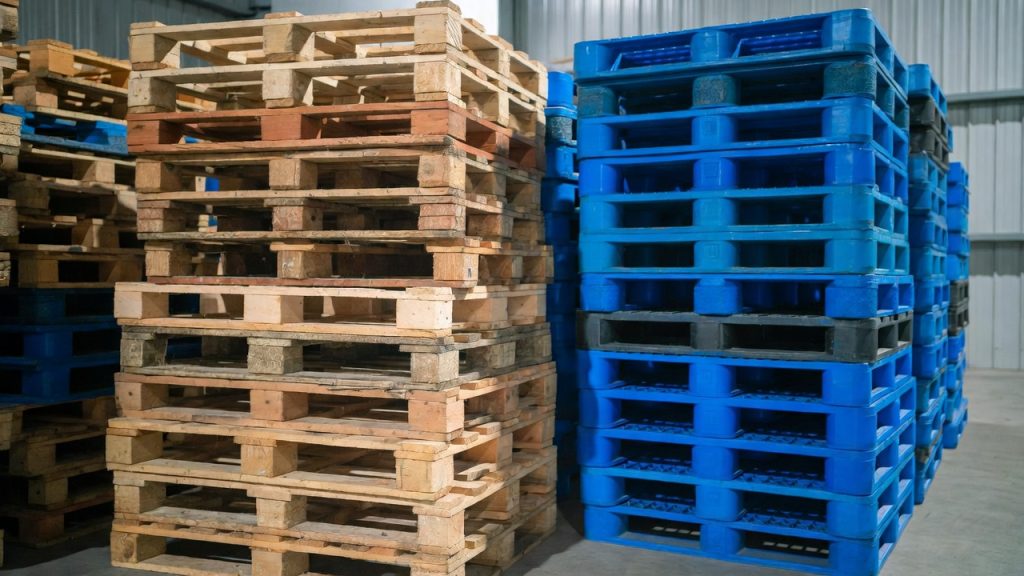
| Plastic pallets | Wooden pallets | |
| ISPM-15 treatment | Exempt — none required | Mandatory heat treatment or fumigation |
| Export stamp needed | No | Yes — IPPC mark |
| Upfront cost | Higher | Lower |
| Service life | Years, many trips | Months to a few trips |
| Weight | Lighter | Heavier |
| Moisture and pests | Does not absorb or harbour | Absorbs water, can harbour pests |
| Cleaning | Washable, non-porous | Difficult to sanitise |
| Splinters and nails | None | Common failure point |
| Repairable | No — replace or recycle | Yes, cheaply |
| Best for | Export, food, pharma, closed-loop, automated systems | One-way domestic, heavy irregular loads, low volume |
What ISPM-15 Actually Requires
ISPM-15 is International Standard for Phytosanitary Measures No. 15, developed by the International Plant Protection Convention under the UN Food and Agriculture Organization. Its purpose is to stop invasive pests travelling between countries inside wood packaging.
The standard applies to solid wood packaging material — pallets, crates, and dunnage. Before it crosses a border, that wood must be treated by one of two approved methods:
- Heat treatment (HT) — the wood is heated until its core reaches at least 56°C and held there for a minimum of 30 minutes.
- Methyl bromide fumigation (MB) — a chemical treatment, now used far less often because of environmental restrictions.
Treated wood is then stamped with the IPPC mark, which carries the country code, the treatment code, and a unique facility identifier. Importantly, there is no accompanying certificate — the stamp on the pallet is the proof.
What happens when it is missing
Customs inspectors at the destination have three options when they find untreated wood packaging, and none of them are good for the shipper. They can order treatment at the destination, at the exporter’s cost. They can order the packaging destroyed and replaced. Or they can refuse the consignment entirely and send it back.
Consequently, the risk is not just the treatment fee. It is the delay, the destination handling charges, and the customer relationship.
Why Plastic Pallets Are Exempt
ISPM-15 exists to control pests that live in raw wood. Therefore, the standard covers raw wood only — and materials that cannot harbour those pests fall outside it entirely.
Plastic pallets are exempt. So are metal pallets, and so are processed wood products such as plywood, oriented strand board, and particleboard, because the manufacturing process already destroys any pest.
This is not a loophole or a concession. A plastic pallet is simply not within the scope of the regulation. As a result, there is nothing to treat, nothing to stamp, and nothing for an inspector to check.
What the Exemption Is Worth
For a Malaysian exporter, the exemption removes four separate things from every shipment.
- The treatment cost — a per-pallet charge on every consignment, repeated indefinitely.
- The scheduling step — sourcing treated stock, or getting untreated stock to a certified facility before the container loads.
- The verification burden — checking that every stamp is present, legible, and valid before the container is sealed.
- The rejection risk — the possibility of a consignment being held, treated, destroyed, or returned at the destination port.
The first is a line item you can calculate. The other three are harder to price but often cost more, because they consume staff time and occasionally an entire shipment schedule.
Furthermore, the exemption removes a compliance conversation with your customer. An overseas buyer who has been burned by a held shipment will ask about your pallet treatment. Plastic ends that question before it starts.
Hygiene — Food, Pharma, and Cleanrooms
Wood is porous. It absorbs moisture, spilled product, and cleaning water, and it cannot be reliably sanitised once contaminated. In addition, nails work loose over time and splinters break off — both of which are foreign-body contamination risks in a food or pharmaceutical environment.
Plastic pallets have a closed, non-porous surface that can be washed, steam-cleaned, or chemically sanitised and returned to service the same day. Consequently, food processors, halal-certified facilities, pharmaceutical manufacturers, and cleanroom operations across Malaysia increasingly specify plastic as a standing requirement rather than a preference.
This applies inside the facility as much as in transit. A wooden pallet that has sat on a wet loading bay and then moves into a production area brings that moisture with it.
The Cost Question, Honestly
A plastic pallet costs more to buy than a wooden one. That is straightforwardly true and worth saying plainly.
However, the comparison that matters is cost per trip, not cost per pallet. A wooden pallet in export service typically makes a handful of journeys before boards split, nails loosen, or it is simply not returned. A plastic pallet in a closed-loop system makes that number of trips many times over.
To work out which is cheaper for your operation, calculate it this way:
- Divide the purchase price by realistic trips. Be honest about your recovery rate — a pallet that leaves and never comes back has a service life of one trip regardless of what it is made from.
- Add the treatment cost per trip for wood. This applies to every export journey, and it does not diminish over time.
- Add repair and disposal. Wooden pallets are cheap to repair but need repairing often. Plastic pallets cannot be repaired, but at end of life they have scrap value as recyclable HDPE rather than a disposal cost.
- Add the freight difference. Plastic pallets are lighter, and on airfreight or volumetric-weight shipments that difference is money on every consignment.
The pattern that emerges is consistent. For one-way domestic shipments with no recovery, wood usually wins on cost. For closed-loop internal use, or for export where treatment is charged on every trip, plastic wins — often decisively.
When Wooden Pallets Are Still the Right Call
Plastic is not the answer to every pallet question, and any supplier who says otherwise is selling rather than advising. Wood remains the better specification in several situations.
- Genuine one-way domestic shipments — where the pallet will not return and no border is crossed, the lower purchase price is decisive.
- Very heavy or irregular loads — timber can be built to unusual dimensions and nailed directly to secure awkward cargo.
- Low volume with no storage — buying a handful of pallets occasionally does not justify investing in a returnable fleet.
- Repairability matters — a damaged wooden pallet can be fixed on site with basic tools; a cracked plastic pallet is replaced.
- Existing certified supply — if you already hold heat-treated stock with a reliable supplier and your export volumes are modest, the switching case is weaker.
Above all, many Malaysian operations run both — plastic for export, food handling, and closed-loop internal movement; timber for one-way domestic and irregular loads. That mixed approach is usually the most economical answer.
How to Choose for Your Operation
| Your situation | Specify |
| Regular export shipments | Plastic — one-way export grade for non-returnable, medium duty for recoverable |
| Food processing or packing | Plastic — washable, non-porous, no splinters |
| Pharmaceutical or cleanroom | Plastic — sanitisable, no foreign-body risk |
| Beam racking storage | Plastic heavy duty — check the racking load rating specifically |
| Automated conveyor or AS/RS | Plastic — consistent dimensions, no protruding nails |
| Closed-loop between own sites | Plastic — the reuse cycles pay back the purchase price |
| One-way domestic delivery | Wood, or one-way plastic if hygiene matters |
| Heavy irregular cargo | Wood — buildable to size |
One specification detail worth getting right
If pallets will sit on beam racking, check the racking load figure specifically — not the static or dynamic load. Static load is what a pallet holds stacked on the floor. Dynamic load is what it holds while a forklift moves it. Racking load is what it holds unsupported across two beams, and it is always the lowest of the three by a wide margin.
Specifying on static load and then racking the pallet is one of the most common and most dangerous mistakes in warehouse procurement. Therefore, always ask for all three figures before ordering.
How NORDVOX Approaches This
NORDVOX has supplied material handling equipment in Malaysia since 1991 and is registered with the Ministry of Finance Malaysia (Reg. No. 357-02238912). The plastic pallet range covers one-way export, light duty, medium duty, and heavy duty rackable specifications — so the pallet matches the journey rather than a single grade being applied to everything.
Browse the plastic pallet range, see the wider material handling products, or contact NORDVOX with your load weights and shipping pattern for a specification recommendation.
Frequently Asked Questions
Do plastic pallets need ISPM-15 treatment?
No. ISPM-15 applies to solid wood packaging material only, because the standard exists to control pests that live in raw wood. Plastic pallets are exempt entirely, so there is no treatment required, no IPPC stamp, and nothing for a customs inspector to verify.
What is ISPM-15?
ISPM-15 is International Standard for Phytosanitary Measures No. 15, developed by the International Plant Protection Convention under the UN Food and Agriculture Organization. It requires wooden pallets, crates, and dunnage crossing international borders to be heat treated to a core temperature of 56°C for at least 30 minutes, or fumigated with methyl bromide, and then stamped with the IPPC mark.
Are plastic pallets cheaper than wooden pallets?
Not to buy, but often over their service life. A plastic pallet costs more upfront and lasts far longer, while a wooden pallet is cheap initially but needs repair, replacement, and ISPM-15 treatment on every export trip. For closed-loop and export use, plastic is usually cheaper per trip. For genuine one-way domestic shipments, wood typically wins.
Which pallets are best for food and pharmaceutical use?
Plastic. Wood is porous, absorbs moisture and spilled product, cannot be reliably sanitised, and presents splinter and loose-nail contamination risks. Plastic pallets have a closed, non-porous surface that can be washed, steam-cleaned, or chemically sanitised and returned to service immediately.
What is the difference between static, dynamic, and racking load?
Static load is the weight a pallet holds while stacked on a solid floor. Dynamic load is the weight it holds while being moved by a forklift or pallet jack. Racking load is the weight it holds unsupported across two beams in a racking system, and it is always the lowest of the three. Always specify on racking load if the pallet will be racked.
Can plastic pallets be recycled?
Yes. Plastic pallets are typically moulded from HDPE or polypropylene and are fully recyclable at end of life, retaining scrap value as raw material. Wooden pallets at end of life are usually a disposal cost rather than a recoverable asset.
Are processed wood pallets exempt from ISPM-15 too?
Yes. Plywood, oriented strand board, and particleboard are exempt because the manufacturing process destroys any pest present in the original timber. The exemption covers processed wood products, not solid timber that has simply been cut or planed.
Does NORDVOX supply plastic pallets across Malaysia?
Yes. NORDVOX has supplied material handling equipment in Malaysia since 1991 and is registered with the Ministry of Finance Malaysia (Reg. No. 357-02238912). Delivery covers all states including Kuala Lumpur, Selangor, Johor, Penang, Sabah, and Sarawak, and NORDVOX also serves clients in Singapore and Brunei.


