
Plastic Bollard Malaysia – Flexible PU Delineator Post with Reflective Sleeve
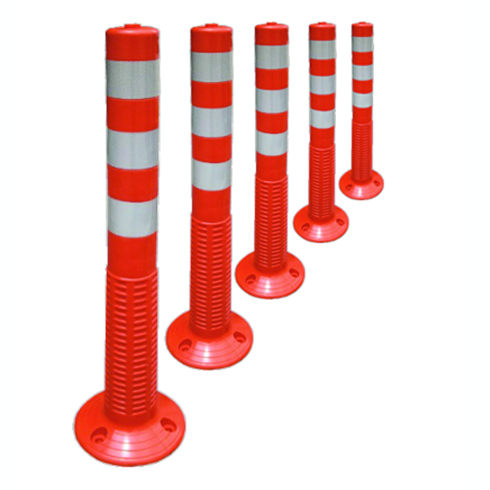
A rigid bollard punishes the vehicle that hits it. A traffic cone gets knocked aside and stays there. This plastic bollard does neither — it bends flat under impact, then springs back upright on its own. As a result, it holds a line in exactly the places where something is going to get hit sooner or later.
Moulded from polyurethane (PU) and ethylene-vinyl acetate (EVA) with a high-visibility reflective sleeve, this flexible delineator post is used across Malaysia for lane separation, car park channelling, road works, and any boundary that needs to be visible day and night without becoming a hazard itself.
Built to Be Hit
Elastomers behave differently from rigid materials under load. Instead of transferring impact energy into the vehicle or shearing at the base, the post deforms, absorbs the energy, and returns to shape. Consequently, a single unit survives repeated contact that would destroy a rigid bollard and would send a cone rolling into traffic.
That matters most in three situations: tight car park turns where wing mirrors and bumpers make regular contact, temporary works layouts that vehicles brush past all day, and lane separation on approach roads where a rigid obstacle would create more risk than it removes.
Key Features
- Flexible PU and EVA construction — bends flat on impact and self-rights, so one unit absorbs repeated contact without replacement.
- High-visibility reflective sleeve — the post stays conspicuous in low light, at night, and in heavy rain.
- Vehicle-safe — because the post yields, it does not dent panels or scratch paintwork on contact.
- Weighted base — the 200mm base holds the post stable against wind and passing traffic turbulence.
- Lightweight and portable — one person can reposition a line of posts, unlike fixed bollards.
- High-visibility orange — the standard road safety colour, recognised on sight.
- No corrosion — plastic does not rust, so posts survive Malaysia’s rainfall and humidity without maintenance.
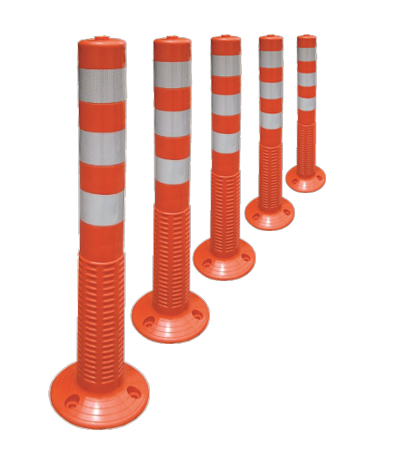
Cone, Flexible Bollard, or Rigid Bollard?
These three products are routinely confused, and specifying the wrong one is expensive. Therefore, choose by how permanent the boundary is and what happens when a vehicle touches it.
| Traffic cone | Flexible bollard (this) | Rigid bollard | |
| On impact | Knocked aside, stays displaced | Bends flat, springs back upright | Stops the vehicle, damages it |
| Installation | Free-standing, no fixing | Free-standing or surface-fixed | Core-drilled or cast-in foundation |
| Repositioning | Instant | Easy | Not possible |
| Best for | Short-term works, incidents, events | Semi-permanent lanes, car parks, repeated contact zones | Permanent boundaries, pedestrian protection |
| Replacement rate | High — lost, crushed, stolen | Low — survives repeated impact | Very low, but costly when damaged |
See the traffic cone range for temporary works, or the stainless steel bollard range for permanent installations. Our bollard specification guide covers the full decision in detail.
Specifications
| Model | PB80 |
| Type | Flexible delineator post |
| Material | Polyurethane (PU) and ethylene-vinyl acetate (EVA) |
| Pole diameter | 80 mm |
| Pole height | 780 mm |
| Base diameter | 200 mm |
| Visibility | High-visibility reflective sleeve |
| Colour | Orange |
| Placement | Indoor and outdoor |
Ideal For
- Car parks — lane channelling, tight turns, ramp separation, reserved bays
- Road works and maintenance — semi-permanent lane closures and diversions
- Petrol stations and drive-throughs — queue channelling and pump island protection
- Warehouses and loading bays — forklift routes and pedestrian walkway separation
- Toll plazas and entry lanes — lane delineation at controlled access points
- Shopping malls and hotels — temporary vehicle routing during events or works
NORDVOX is registered with the Ministry of Finance Malaysia (Reg. No. 357-02238912) and supplies through the ePerolehan procurement system. Bulk orders welcome for contractors, councils, and facility operators. Contact NORDVOX for pricing and nationwide delivery.
Frequently Asked Questions
What is a flexible plastic bollard?
A flexible plastic bollard, also called a delineator post, is a bollard moulded from elastomers such as polyurethane and EVA. It bends flat when struck by a vehicle and springs back upright on its own, rather than breaking or damaging the vehicle. This makes it suited to boundaries where occasional contact is expected.
Will a plastic bollard stop a vehicle?
No, and it is not designed to. A flexible bollard marks and delineates a boundary while surviving contact. Stopping a vehicle requires a rigid crash-rated bollard with an engineered foundation, which is a different product class entirely.
What is the difference between a traffic cone and a flexible bollard?
A traffic cone is free-standing and gets knocked aside on contact, so it suits short-term works where layouts change daily. A flexible bollard stays in position and self-rights after impact, which suits semi-permanent lanes and car park channelling where the same boundary is needed every day.
Does the plastic bollard need to be fixed to the ground?
The weighted 200mm base holds the post stable in most applications without fixing. However, for permanent lane delineation or exposed locations with high wind, surface fixing through the base is recommended.
Are plastic bollards visible at night?
Yes. Each post carries a high-visibility reflective sleeve that returns vehicle headlight beams, keeping it conspicuous in darkness, heavy rain, and low-light conditions.
Does NORDVOX deliver plastic bollards across Malaysia?
Yes. NORDVOX has supplied road safety equipment in Malaysia since 1991 and is registered with the Ministry of Finance Malaysia (Reg. No. 357-02238912), including supply through ePerolehan. Delivery covers all states including Kuala Lumpur, Selangor, Johor, Penang, Sabah, and Sarawak.